- About YAS
- Travel Insurance

- GPS Sport
- Lifestyle Protection
- Personalised Coverage
- YAS Robotics
- About Claim


Robots and humanoids, finally insurable.
YAS scores each machine live from its telemetry — the risk signal a licensed insurer needs to cover what standard policies never could. Per unit, per deployment.
Traditional insurance can't price the way autonomous machines fail.
Delivery bots, warehouse AMRs, port cranes and humanoids are already deployed across Asia — almost all of them uninsured. Traditional underwriting rests on three things: hard evidence of a loss, risks that fail independently, and a base rate that holds for a year. Autonomous machines break all three, and there's no actuarial history for a machine that's never existed — so the risks that matter most are the ones a standard policy can't even see.
| risk type | legacy insurance | what's left exposed | sensor data captured |
|---|---|---|---|
| Physical damage & theft | Covered | — | — |
| Repair & warranty | Covered | — | — |
| Third-party liability | Covered | — | — |
| Decision risk | Not Covered | "The robot chose a harmful path" — no such clause exists. | Disengagements · near-miss rate |
| Fleet-wide failure | Not Covered | One firmware push downs a hundred units — one event, not a hundred claims. | Version manifest · rollout radius |
| Sensor degradation | Not Covered | Risk climbs before any incident — there's no claim to file. | Calibration drift · sensor health |
| Adversarial & cyber | Not Covered | The loss looks ordinary; the cause hides in the data. | Command integrity · sensor anomaly |
| Model & version drift | Not Covered | Each software update resets the risk; an annual price is stale in a sprint. | Build version · distribution shift |
| ODD breach | Not Covered | Risk spikes the moment a machine leaves its safe envelope. | Geofence · operating context |
Physical damage & theft
CoveredRepair & warranty
CoveredThird-party liability
CoveredDecision risk
Not Covered"The robot chose a harmful path" — no such clause exists.
Disengagements · near-miss rate
Fleet-wide failure
Not CoveredOne firmware push downs a hundred units — one event, not a hundred claims.
Version manifest · rollout radius
Sensor degradation
Not CoveredRisk climbs before any incident — there's no claim to file.
Calibration drift · sensor health
Adversarial & cyber
Not CoveredThe loss looks ordinary; the cause hides in the data.
Command integrity · sensor anomaly
Model & version drift
Not CoveredEach software update resets the risk; an annual price is stale in a sprint.
Build version · distribution shift
ODD breach
Not CoveredRisk spikes the moment a machine leaves its safe envelope.
Geofence · operating context
From first unit to live coverage in three steps.
Connect the fleet. Let the ARIA engine score it. Coverage and payouts follow the telemetry, not the calendar — YAS supplies the signal, the licensed insurer sets the price.
Connect the fleet
Push operational telemetry into the YAS API — ROS middleware, vendor SDKs, IoT gateways, fleet-management platforms. Coverage activates per unit, per deployment, the moment a robot comes online.
Score each unit
Movement, load, environment, sensor health, software version — the ARIA engine reads them as a single risk signal and scores each unit against its own behaviour, not the fleet average. As the fleet runs, that signal becomes the loss history this category never had.
Pay out on triggers
Threshold breach, collision, overload, environmental anomaly — the telemetry fires the insurer's pre-authorised response: an alert, a policy adjustment, or an automatic payout. The operator doesn't fill in forms; the data does.
From a live risk score to protection legacy can't price.
The ARIA engine scores each unit from its telemetry — and that one signal is what an insurer prices against. So coverage can finally reach the emergent failures standard policies were never built to hold. Traditional cover comes included, table stakes off the same signal.
Live risk scoring
The ARIA engine reads each unit's telemetry — movement, load, sensor health, software version — and turns it into a live per-unit risk score. That one signal is the input every downstream price, policy and payout is built on.
Correlated, fleet-wide failure
One firmware push or model update can down a hundred units at once. YAS reads the rollout's blast radius as it spreads, so an insurer can price the aggregated event standard policies can't hold.
Autonomous-decision liability
When the machine's own decision causes harm — "the robot chose a harmful path" — the planner and disengagement logs score the exposure, so the licensed insurer can cover a risk no standard clause was written for.
Cyber & adversarial
Spoofing, jamming, sensor manipulation, remote takeover. Anomaly patterns in the live stream flag the event and trigger protection legacy motor cover never contemplated.
Parametric payouts
Sensor thresholds and anomaly triggers fire the insurer's pre-authorised payout directly — anomaly to settlement in hours, the scoring engine doing the work no claims form could.
Standard cover, included
Physical damage, third-party liability, repair and warranty come as table stakes — priced off the same live signal, not a separate annual quote.
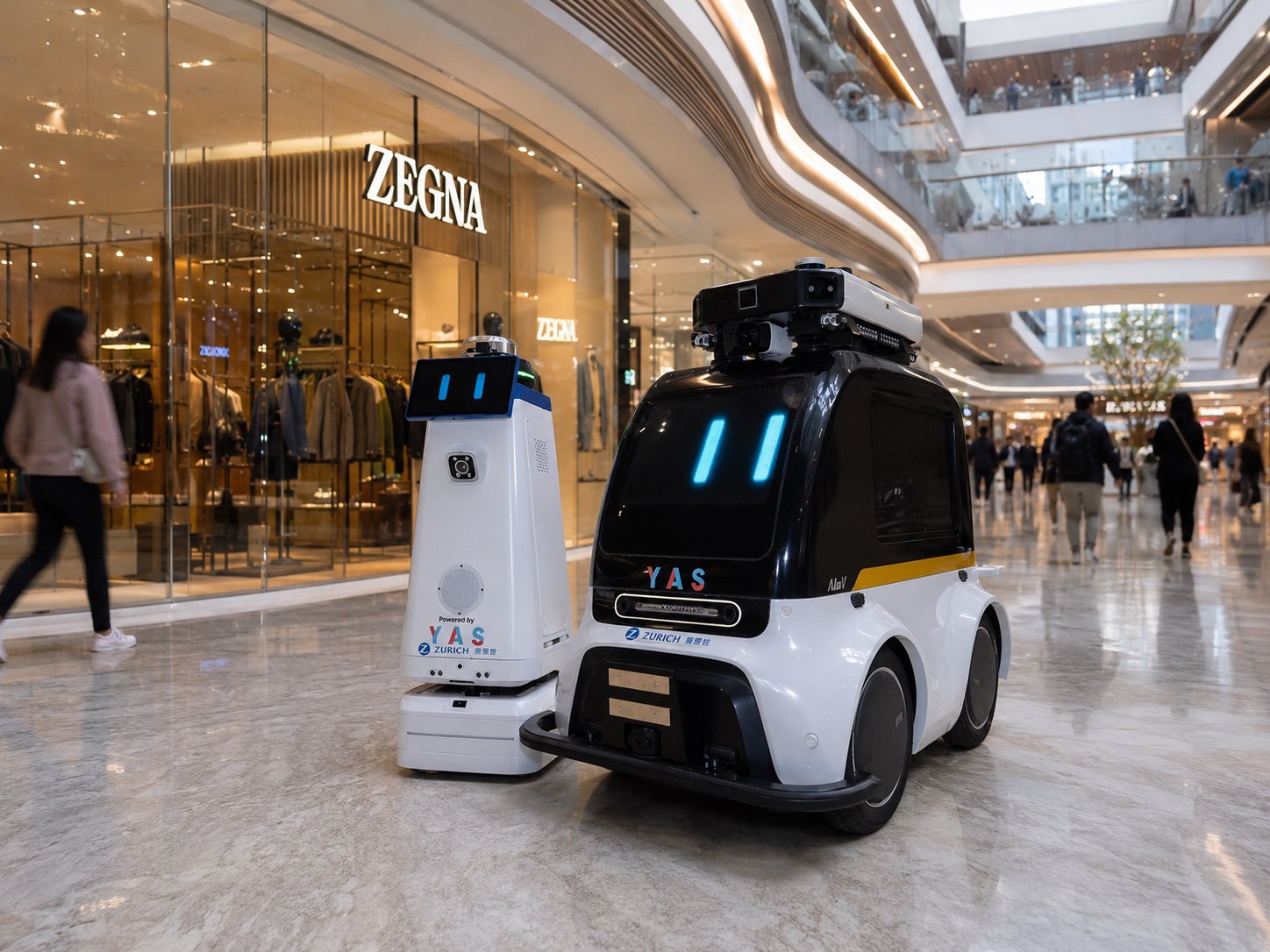
100 patrol robots across Hong Kong, already live.
AIMO runs a security-robot fleet across commercial properties in Hong Kong. YAS reads telemetry; YAS Assurance sits on top of Zurich's standard cover as the reserve-backed tail-risk layer — built for the eight failure modes a standard policy was never written for.


Quick answers before you deploy.
What gets covered, what gets priced, what the API expects.
What kinds of robots can YAS price?
Delivery and sidewalk robots, warehouse AMRs, port cranes, service and hospitality bots, industrial arms, and humanoids. Anything that streams operational telemetry — directly or through a fleet manager — can be onboarded.
How does per-unit pricing actually work?
Each robot is registered via the API and given its own risk profile — type, environment, operational parameters. YAS scores it; the licensed insurer prices off the score. Coverage activates one unit at a time, so the fleet doesn't get a blanket policy — it gets a portfolio of individually scored, individually priced units.
What telemetry do you accept?
Any sensor stream, ROS middleware feed, fleet management platform, or IoT gateway. Movement, load, environmental readings, operational state, software version — all normalised into YAS's risk model.
How are parametric payouts triggered?
Configurable rules watch the live telemetry streams. When a threshold is crossed — collision, overload, environmental breach, software regression — the system fires the insurer's pre-authorised response: an alert, a policy adjustment, or a payout, without manual adjudication.
Where is coverage available?
YAS operates through locally licensed insurer partners across multiple markets. Each territory pairs with a regulated underwriter, so the policy stays compliant where it's issued.
What's the minimum fleet size?
From ten units through to enterprise deployments of 5,000+. Smaller pilots are welcome — the platform was built to grow with the deployment, not to require it upfront.